European Projects
Artex is committed to the implementation of EU and international cooperation projects, with the primary objective of promoting and supporting all expressions of artistic and traditional craftsmanship.
Artex’s commitment in this direction is supported by a network of businesses and public and private professional organizations operating in the craft sector at national, European, and international levels. A concrete result of this strategic collaboration over the years has been the implementation of numerous events, projects, and activities.
A notable example is the “Crafting Europe” program, funded by Creative Europe and ended in 2022, aimed at promoting the integration of new technologies with traditional craft skills through cross-contamination between artisans, designers, and digital creatives. In addition to implementing the program’s activities, Artex managed the communication and dissemination of Crafting Europe, including the final publication, which is still available for download on the project’s website.
Artex is a partner in two Horizon Europe projects and two Erasmus+ projects:
- Tracks4Crafts (Transforming crafts knowledge for a sustainable, inclusive and economically viable heritage in Europe) – Horizon Europe 2023–2027, aims to analyze and improve the transmission of traditional crafts knowledge (TCK) to promote the social and economic value of craftsmanship, aligning with a forward-looking approach to European heritage. Artex is leading a pilot case in the ceramics sector, Ceramic Futures, offering workshops and seminars, both in-person and online, to introduce new technologies, techniques, and strategies. These activities aim to strengthen artisans’ entrepreneurial and creative skills by offering innovative lifelong learning paths.
- ELLIE (on the UsE of Internet of Senses for the CuLturaL HerItagE) – Horizon Europe 2025–2027, seeks to use technology to enhance and preserve cultural heritage, making it accessible and engaging for all. It combines traditional practices with digital innovation to create immersive and interactive experiences. The goal is to connect people with history and promote new forms of cultural engagement. Artex, together with the University of Florence and the UniFi Foundation for Research and Innovation, is developing a pilot case to support Florentine craftsmanship in product design, using new technologies to enhance creations.
- BRICKS (Building Bridges Building Skills) – Erasmus+ 2024–2026, aims to strengthen non-formal craft education as a complementary path to formal learning, revitalizing traditional trades, preserving territorial identity, and promoting innovation for future generations. The project will conduct research on non-formal adult education models in various European countries, analyzing policies, practices, and challenges in the craft sector. Through surveys and study visits, data and direct experiences will be collected, and recommendations will be developed to improve non-formal craft training. Artex is involved by engaging stakeholders in study visits and actively contributing to research and data analysis to address the challenge of training in the artistic craft sector.
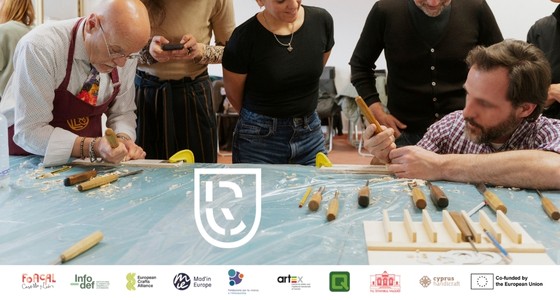
- Reskilling Crafts (Testing a new model of inclusive reskilling labs to boost the digital and sustainable future of the Craft Sector) – Erasmus+ 2025–2027, is a European project aimed at reskilling the craft sector to meet the challenges of the digital and green transition. The main actions include: inclusive reskilling labs—practical and inclusive training paths that promote lifelong learning and employment growth in Europe; the establishment of the European Craft Sector Reskilling Alliance (ECSRA), a collaborative network of artisans, trainers, and innovators; and the creation of a digital platform (CRAFT Reskilling Labs Platform), a multilingual hub offering training content, guidance tools, micro-certifications, and skills monitoring.
European projects plays a key role in Artex’s activities, establishing it as an important reference point for international experimentation and research in the artistic craft sector. These collaborations between different countries offer a broader perspective on the sector and help bring the needs of Italian artistic and traditional craftsmanship to the attention of Europe.
Latest news
-
 16 September 2026
 -
 25 June 2026
 -
 27 May 2026
 -
 18 February 2026